Crystal and Glass Lighting
Lighting 'crystal' spans K9 borosilicate optical glass (n≈1.516, no lead added) and leaded crystal glass (≥24% PbO, n≈1.545+).
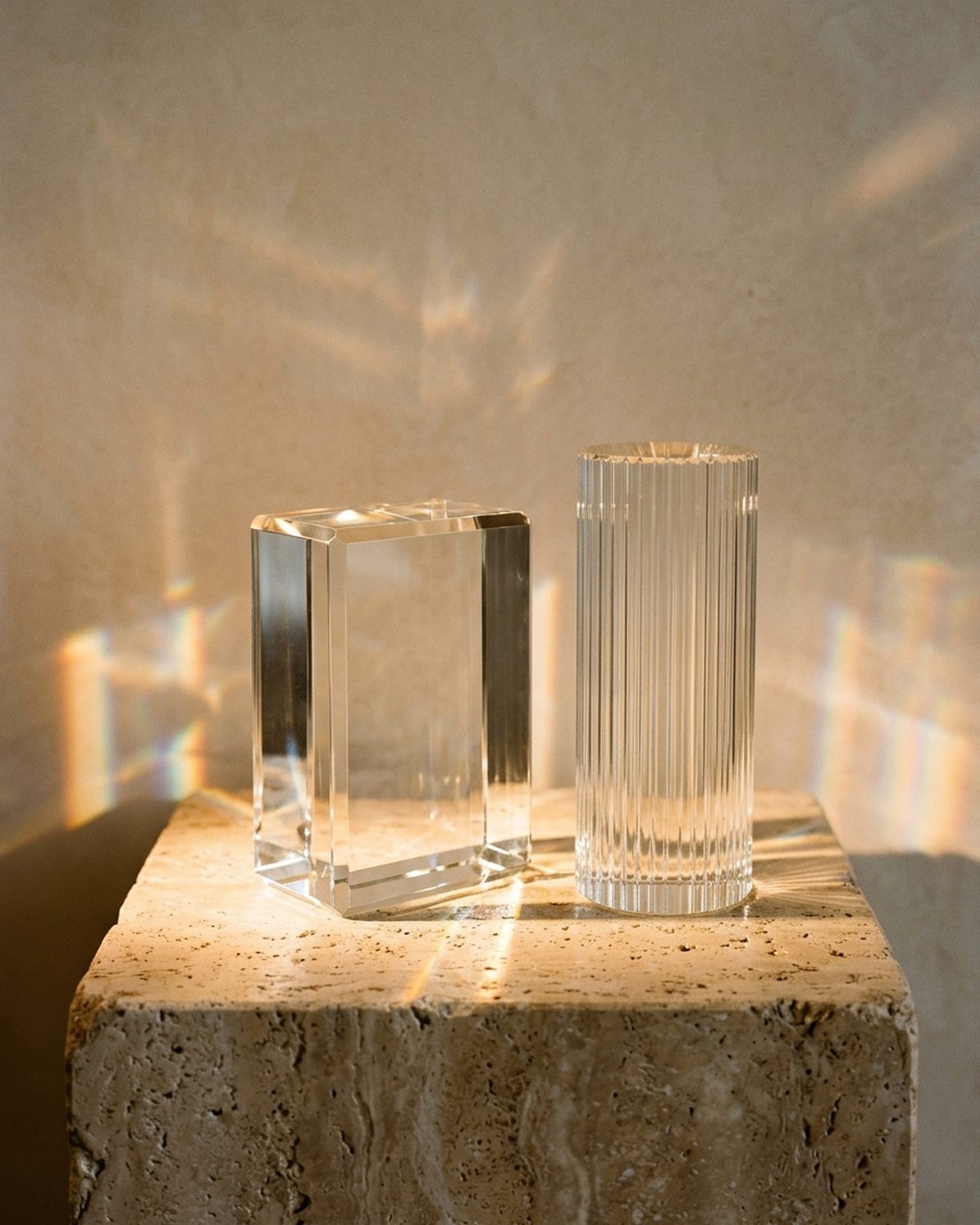
In Guzhen showrooms and online listings, almost every clear faceted lamp part is called “crystal.” Physically, decorative lighting uses three very different transparent materials: K9 optical borosilicate crown glass, leaded crystal glass (containing lead oxide, PbO), and pressed soda-lime glass or acrylic. Choosing the right one affects prism dispersion, lamp weight, surface hardness, price, and California Proposition 65 labeling.
Quick comparison of lighting glass and crystal grades
| Material | Composition | Refractive index (nd) | Density (g/cm³) | Where it makes sense |
|---|---|---|---|---|
| K9 optical crystal (crown glass) | Borosilicate optical glass; no lead oxide added | ~1.516 | ~2.51 | crisp CNC-ground facets, lighter structural load, scratch-resistant table lamps and architectural drops without lead warnings |
| Leaded crystal glass | Silica glass fluxed with ≥24%–30% lead oxide (PbO) | ~1.545–1.57+ | ~2.9–3.1+ | Higher chromatic dispersion (“rainbow fire”) and heavier hand-feel; requires California Prop 65 lead disclosure |
| Pressed soda-lime glass | Standard window/bottle silicate glass, mold-pressed without wheel polishing | ~1.51–1.52 | ~2.50 | Budget fixtures; rounded mold seams blur light rather than splitting sharp spectral beams |
What matters more than material name: facet geometry and wheel polishing
A poorly polished leaded piece looks duller than a sharp, wheel-polished K9 prism. In Guzhen crystal cutting shops, raw blanks pass through rough diamond grinding, fine smoothing, and cerium-oxide felt polishing. Skipping the final polish — or flame-polishing edges to save labor — rounds the facet junctions and kills crisp refraction.
References
Sources
- Council Directive 69/493/EEC on crystal glass categories (≥24% and ≥30% PbO definitions), EUR-Lex (accessed )
- Optical Glass K9 (BK7 equivalent) Refractive Index Data, RefractiveIndex.INFO (accessed )